

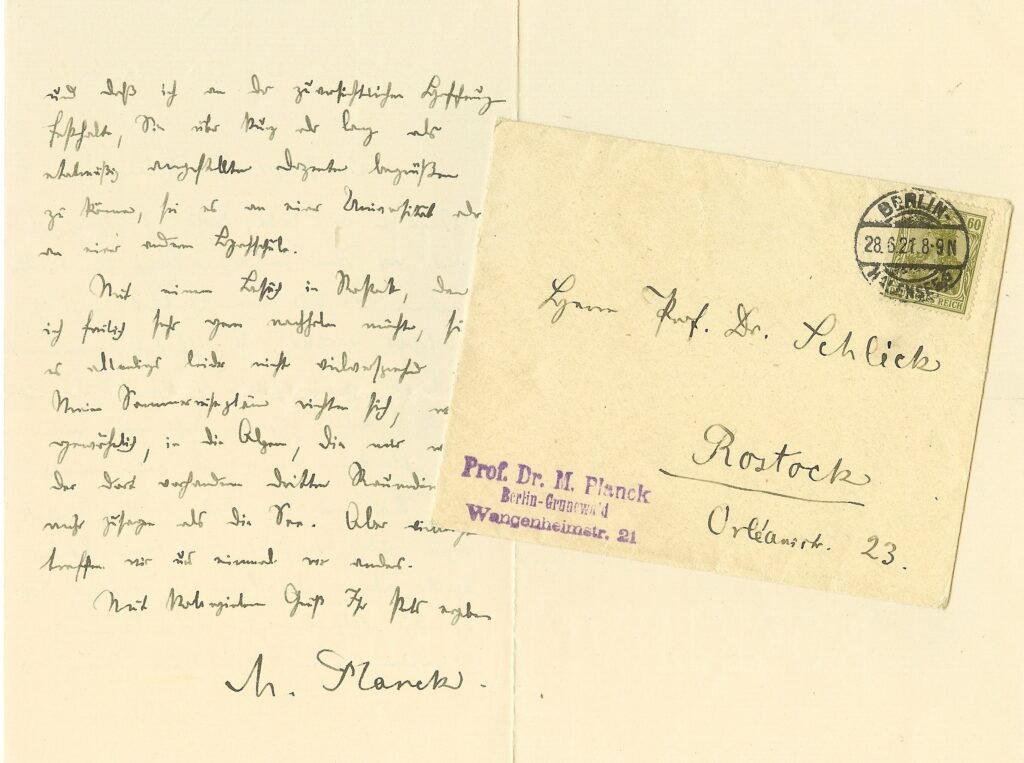
QUANTUM THEORY PIONEER MAX PLANCK TO MORITZ SCHLICK
DESCRIBING HIS EFFORTS TO SECURE SCHLICK’S APPOINTMENT AS A PROFESSOR IN KIEL
PLANCK, MAX. (1858–1947). Nobel Prize–winning German physicist who pioneered the understanding of Quantum Theory. Scarce Autograph Letter Signed “M. Planck”, in German. 2 full pages, octavo. “Berlin-Grünewald, June 28, 1921” To the philosopher Moritz Schlick (1882-1936), founder of the Vienna Circle. Planck writes:
“Dearest colleague: Please excuse me for only replying today to your kind letter of the 18th of this month, and for not doing so at the length I would have liked under normal circumstances. So many things have piled up at once, that it’s impossible to do everything as one would wish.
It is a pity that your appointment in Kiel has not yet materialized—I would have been delighted. But rest assured that I will not rest from raising my voice, in the sense you already know, and that I firmly hope to see you again sooner or later in a new position, whether at a university or another institution of higher education.
Unfortunately, it doesn’t seem very likely that we’ll meet in Naples, a meeting I would, of course, very much like to make happen. As usual, I’ll be spending the summer months in the Alps; that third spatial dimension I find there is more appealing to me than the sea. But perhaps we’ll manage to meet somewhere else.
With warm regards, your ever-attentive servant, M. Planck”
In the early decades of the 20th century, two great figures of the German scientific environment forged a cordial, and friendly bond, significant for the history of science: the physicist Max Planck – father of Quantum Theory, and the philosopher Moritz Schlick – founder of the Vienna Circle. Their relationship began in the classrooms of the Friedrich-Wilhelms-Universität Berlin, lasting for two decades, and reached one of its most concrete and best-documented moments in June 1921—the time of our letter—when Schlick was confirmed as a full professor at the Christian-Albrechts-Universität of Kiel, the city where Planck had begun his own university career thirty-six years earlier.
Schlick studied physics in Berlin, becoming a student of Planck and Emil Warburg, under whose supervision he defended his doctoral thesis in 1904 on the reflection of light in a non-homogeneous medium, a work of classical Optics. After his doctorate, Schlick turned away from experimental physics to dedicate himself to Epistemology, but he never broke contact with Planck or the circle of Berlin physicists. This dual training, a distinctive feature of his work, allowed him to disseminate the scientific advances of the time from a philosophical perspective. Thus, in 1917 he published Raum und Zeit in der gegenwärtigen Physik (Space and Time in Modern Physics), a philosophical introduction to General Relativity that earned Einstein’s praise, and in 1918 he published his major work, Allgemeine Erkenntnislehre (A General Theory of Knowledge), a work on epistemology based on the complex advances of recent physics, mainly as developed in the German academies.
In 1921, Schlick held a modest position in Rostock and was unsuccessfully seeking a permanent university chair amidst the economic crisis of postwar Germany. At the urging of several professors, on May 7, 1921, the Christian-Albrechts-Universität Kiel submitted a formal proposal to the Prussian Ministry of Science, Arts, and Public Education to appoint Schlick as a professor, arguing that, “also according to the judgment of Dr. Planck and Dr. Einstein,” his philosophical work demonstrated a “complete mastery of modern physics.” The mention of Planck and Einstein was significant, as Planck had received the Nobel Prize in Physics in 1918 and was the Permanent Secretary of the Prussian Academy of Sciences, while Einstein, already an eminent figure, would receive the Nobel in 1922.
The informal support of Planck and Einstein led to Schlick’s appointment, since Schlick became Ordentlicher Professor für Ethik und Naturphilosophie in Kiel in the summer of 1921. A year later, in 1922, Schlick was invited by the Universität Wien (Vienna) to become Ordentlicher Professor für Philosophie der Induktiven Wissenschaften, a position vacant since the death of Ernst Mach, and previously held by Ludwig Boltzmann. There, Schlick gathered around him a group of mathematicians, physicists, and philosophers—Hans Hahn, Otto Neurath, Rudolf Carnap, Herbert Feigl, and Friedrich Waismann—who began meeting regularly around 1924 and would eventually become known as the Vienna Circle, the birthplace of logical positivism, one of the most influential currents in 20th-century philosophy.
The historical context of this episode cannot be overlooked. It was the Germany of the early Weimar Republic: a defeated nation, plagued by rampant inflation and political instability, menaced by the rise of nationalist forces that would eventually lead to Nazism—indeed, on June 22, 1936, on the steps of the University of Vienna, Schlick was murdered by his former student Johann Nelböcke, a mentally disturbed man who accused Schlick of driving away his beloved by failing to promote his career, and also of offering pro-Jewish lectures from his professorship. When Schlick was murdered, Planck publicly expressed his dismay at the death of his friend physicist-turned-philosopher, whom, fifteen years earlier, in 1921, he had helped to carve out a place for himself in German university life.
A letter of some significance. Such choice associations are highly desirable and this letter will make a fine addition to any collection.
$2350.00