

HENRY MILLER
A REMARKABLE AND IMPORTANT ARCHIVE OF NEARLY 100 LETTERS COVERING THE LAST 2 YEARS OF HIS LIFE
HENRY MILLER (1891-1980) stands among the most influential and important American authors of the twentieth century. Known for breaking with existing literary forms in the pursuit of a new sort of “novel,” Miller’s literary works, a mixture of fiction, autobiography, social criticism, and surrealist free association, remain incredibly difficult to categorize even in the postmodern age. Through these works, as well as in interviews, Miller hoped to inspire a break from the empty materialism that he felt pervaded the world and a concomitant creation of a new religion of body and spirit.
A champion of the sanctity of art, Miller is best known for his fictional-autobiography of his experiences in Paris, The Tropic of Cancer, and the obscenity trial its publication led to in the U.S. Upon its U.S. publication in 1961, the novel became the focus of a series of trials that tested the legal definition of pornography in America. In a groundbreaking decision, the United States Supreme Court overruled earlier court findings and declared the book to be a work of literature. It was a milestone for American literature that paved the way for the work of subsequent artists like the Beat Generation’s William S. Burroughs and Allen Ginsberg.
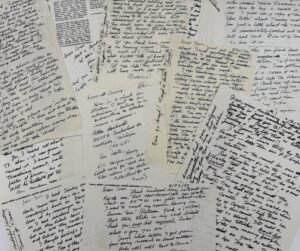
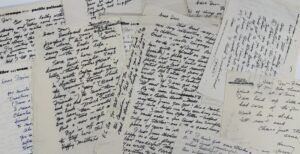
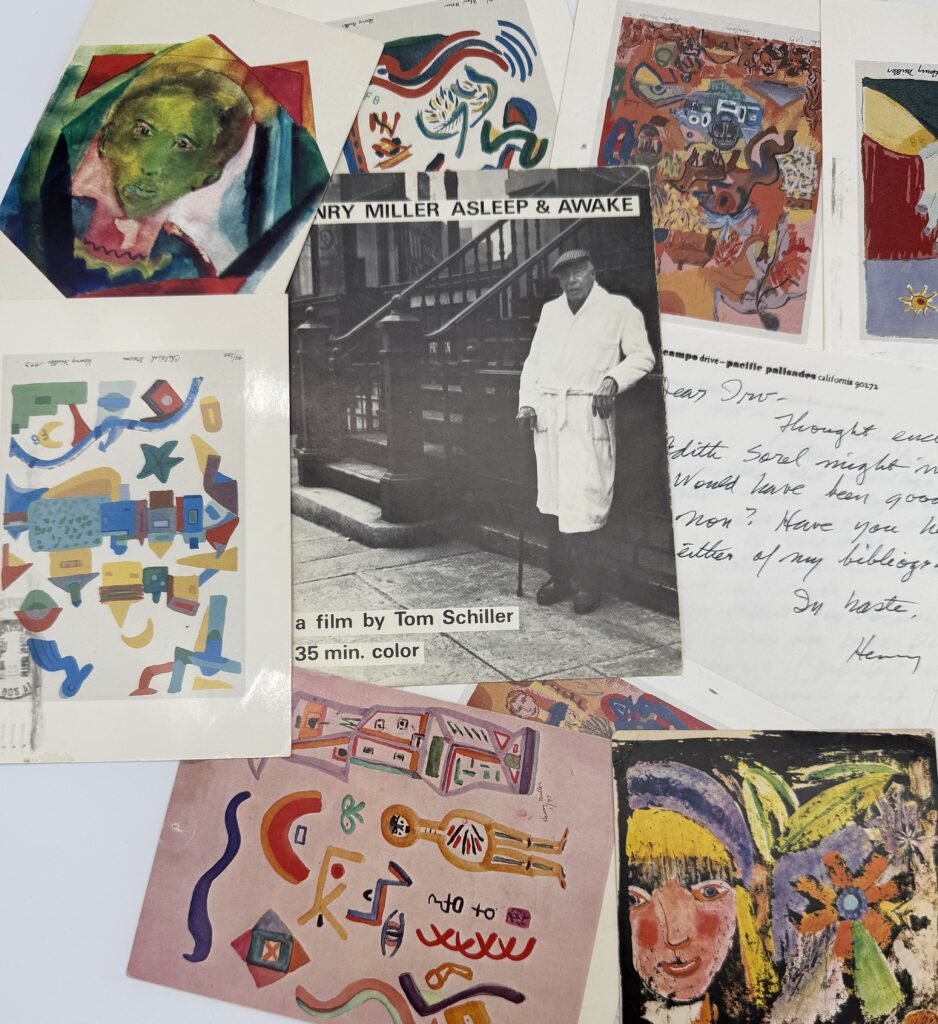
This archive, composed of 84 Autograph Letters and twelve postcards written to Irving Stettner, an accomplished writer and painter, and editor of “Stroker” magazine, spans the final two years of Miller’s life, offering an enlightening glimpse into the mind of an artist whose output, both visual and literary, was only slowed by his death. In our letters, Miller discusses a number of his own literary endeavors, upcoming art events, and his thoughts on other writers, including a scathing critique of the iconic poet of the 1970s; Allen Ginsberg.
Although Miller’s boundary breaking works paved the way for the Beat movement and played a part in the sexual revolution of the same period, he writes Stettner that:
“I never belong to any movement, any cult or ism. At 21 I was an anarchist and have remained one all my life.”
Regardless, he remained attentive to the nature and effects of the literary and social movements in his contemporary society. To him, the sexual revolution fell far short of what it should be; the personal liberation it offered had never materialized. Like this failed social revolution, Miller finds that Allen Ginsberg, the leading poet of the Beat movement, had similarly promised much and given little. Miller, who praised William S. Burroughs’ Naked Lunch and wrote an introduction for the 1959 edition of Kerouac’s The Subterraneans, was decidedly less than enthusiastic concerning Ginsberg’s contributions to contemporary culture and art. Modern poetry in general left Miller cold, and, in the earliest letter of this archive, March 6, 1978, Miller, thanks Stettner for the gift of a surprisingly resonant poem and watercolor, writing that he and his son Tony were
“bowled over by both items and neither of us cares much about modern poetry (except Rimbaud and the likes)…Because of your poem I may try to do one myself, only wrote 4 or 5 in all my life”
But Stettner and Rimbaud, the latter of whom had been the subject of Miller’s The Time of the Assassins, were the exceptions to the rule; as he informed Stettner on February 24, 1978, “…since 1930, I have read no American poetry. Is it a big loss on my part?” A few months later, in May of 1978, Miller, having apparently read some Ginsberg, American’s best known comtemporary poet, wrote:
“I don’t like Alan [sic] Ginsberg- neither himself, his work, or what he represents. I don’t think his contribution should be published in the chap book. In “Stroker” OK but not with me in Chap Book. If he is a good friend of yours I hope I am not hurting your feelings. With his Buddha take off he could just as well be a Jesus freak. I’ve heard + seen him on T.V. Just can’t stand him. Forgive me.”
In place of Ginsberg’s work, which Miller views as a distressingly imitative, commercialized representation of Buddhist thought, he proposes that
“a paragraph from Hesse’s Sidartha [sic] would be a thousand times better- if you actually need fill in.”
Miller, drawn to Hesse’s masterwork, often recommended it to friends and acquaintances; he even brought the work to the attention of New Directions Publishing Corp., thus providing the company its first profit.
Miller, seeking to show Stettner that his deep aversion to Ginsberg is not a personal grudge, takes up this subject once again in another, this time undated, letter, opining,
“If you agree with me about Ginsberg’s text (friend or no friend) do look again at the very last chapter of Siddhartha. What if refer to is where S – tries to explain to his old friend Govinda the secret of the art of living. He picks up a stone and starts talking. From there on you will see what I mean. And you’ll also see the difference between Ginsberg and Hesse-or/and the real Buddha. Siddhartha meets the historical Buddha if you remember, pays his respects to time but adds “I have to find my own way…” Hope I make myself clear”
Ginsberg’s work was, to Miller, the apotheosis of a failed and increasingly shallow sexual revolution and, as such, could not possibly compete with Hesse’s Buddhist masterpiece. Regardless of his strong feelings concerning Ginsberg, his art, and public persona, Miller showed great discretion in the postscript of this letter, requesting that Stettner, who, like himself, had contact with many of the Beats,
“please don’t tell Ginsberg what I think of him. I really don’t hate- just can’t abide him.”
For Miller, Stettner’s Stroker proved to be the ideal forum for his work. A small run magazine devoted to presenting the best artists of the period, Miller understood that Stroker filled an important gap in the literary landscape. More importantly, it was a magazine that Miller felt proud to contribute to,
“I like the idea of writing for your mag (for nothing) rather than some big shit of a mag.”
Fearing that Stettner might abandon the costly magazine to devote more time to his own painting and writing, Miller, in a letter dated “Maundy Thursday,” offered Stettner the following words of encouragement,“I am writing to encourage you to keep Stroker alive. It is beginning to hit the right people, I feel. I want to send you names of more prospects, and I will, soon as I can make time. You are on the right track (second Ave. Patrol). From that ghetto you can reach the world. Fare better than a Madison avenue address, believe me.”
Stettner, although feeling the pressures of running a small press, thankfully took Miller’s advice. As could be expected, Miller offered more than just emotional support and articles to Stettner’s Stroker. Throughout these letters he provides names (and at times addresses) of leads for new subscribers for the magazine and offers monitory support during difficult times. Gaining recognition steadily over the first years of its publication (due in no small part to the contributions and assistance of Miller) the magazine soon developed a devoted base of subscribers. Appearing every three to five months, Stroker consistently offered some of the best contemporary fiction to its readers until its publication was suspended with the 2004 death of its founder, Irving Stettner.
Widely regarded for his literary achievements and the far reaching effects of his groundbreaking novels, many individuals remain unaware that Miller was actually a watercolorist long before he ever set pen to paper. In fact, Miller, despite the fact that he did not consider himself to be an ‘artist,’ created over two thousand watercolors throughout his lifetime and held shows in more than sixty major international exhibitions! In May of 1978, a catalogue of Miller’s watercolors was printed by the Coast Gallery of Big Sur, but of greater interest to Miller was the upcoming Exhibition in Tel Aviv. After judging closed at the Tel Aviv exhibit, Miller excitedly wrote Stettner a few lines on a postcard containing a photograph of Miller “Symbolique” watercolor,
“Just got word that I won first prize in Tel. Aviv International Art Show. But no sales of paintings- Israelis too poor. Anyway, I wept!”
Although Miller claimed in a 1969 interview that he had written himself out and turned to painting instead, the last decade of his life saw the publication of revised editions of his earlier works, collections of essays and sketches, studies of Yukio Mishima and D. H. Lawrence, travel accounts of Greece, notebooks, and letters, as well as a number of popular collections of his writings. It is this unfailing creative drives that comes through in these letters. Take his letter from June 14 1978, where Miller informed Stettner, that, though sick, he was:
“writing my head off. Just corrected typescript for Vol. III Book of Friends- don’t know yet what title to give it as it is a mixture of ten women’s portraits (short ones) and a long chapter on “Alf” (Perles) [Alfred Perles, Australian-British writer and Miller’s close friend]”
Miller, working on the corrections to this novel length work and painting on a daily basis, refused to be slowed by his health concerns. While he does complain that eye troubles forced him to cut some letters short and read more slowly than he once could, his mind remained sharp as ever and his output suffered comparatively little from the obstacle of poor eyesight: “Still waiting for oculist to come see me –can’t do any work meantime, tho’ half-blind I wrote 2 stories for my “Joey” Book” (March 22, 1979). Before Vol III Book of Friends had even appeared on the shelves, Miller, unable to contain the rush writing gave him, informed Stettner that:
“I’ve just finished a piece about “The Theatre,” which Sandy is typing for me. Twelve pages long. And now I have just added an ‘Epilogue” of three handwritten pages. All this I wrote with the intention of giving it to Stroker I hope you can use it in a coming issue. Yesterday I learned from my agent (Bettye McCarrt-A Agency for Artists) that the ten short pieces from “Joey” had all been refused by Esquire and Westways. Just as I thought. These birds still don’t know who I am, what I’m doing. But Stroker does! Before “Joey” (Vol. 3 Friends) goes to press next couple of months I’ll see if Noel Young (Capra Press) has any objections to my sending you these short stories about women. I think they are right up your street, Irv. Anyway, let’s hope. I enclose notes sheet for guide to theatre article. The Epilogue is the best- wait till you see.”
Simply stated this is just a highly important grouping of his letters, that can not be duplicated. The bulk of this archive is over an inch thick and weighs several pounds! Simply irreplaceable and worthy of further study and research by literary historians.
$44,500.00