

NAPOLEON BONAPARTE
TO HIS MINISTER OF FINANCE REQUESTING SPECIAL FUNDS BE MADE AVAILABLE FOR THE EXPENSES OF THE WAR IN SPAIN
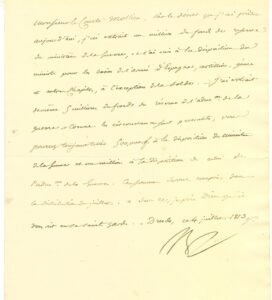
NAPOLEON I. (1769-1821) French military and political leader; Emperor of the French, who consolidated and institutionalized many reforms of the French Revolution of 1789. Good Manuscript Letter Signed, in French, with a bold flourish “Np”. Full page, quarto. Dresden, July 4, 1813. To his Minister of Finance, Count Mollien. Very fine condition. Napoleon dictates:
“By the decree I have issued today, I have taken one million from the reserve fund of the Ministry of War, and I have made it available to the Minister for the needs of the Spanish army: artillery, engineers and other chapters, with the exception of the soldiers’ salaries.
I have also withdrawn 5 million francs from the War Administration’s reserve fund. As the circumstances are urgent, you may always keep 500,000 francs at the disposal of the Minister of War, and 1 million at the disposal of the War Administration. These sums will be included in the July distribution.
With this, I pray to God keeping you in His holy care. N[a]p[oleon].”
On May 5 and 6, 1808, in the French city of Bayonne, Napoleon Bonaparte forced the abdications of Carlos IV and his son Fernando VII from the Spanish throne, a process that culminated a few weeks later with the coronation of José I, Napoleon Bonaparte’s brother, as the “legitimate king” of Spain. These events were the political prelude to the French occupation of the Iberian Peninsula, which would last until 1814, when, after the French defeat at the Battle of Vittoria, the occupation ended and the occupying army liberated the Spanish territory and Fernando VII, who had been imprisoned until then, returned to the throne.
This letter represents one of Napoleon’s last administrative efforts to retain control of Spain. It reveals both his weakness during 1813 and the emerging globalization of political and military conflicts. Indeed, through this request to his Minister of Finance, Count Mollien, Napoleon authorized increased military spending on the peninsula, even though he could not guarantee the soldiers’ pay. It was undoubtedly a desperate gesture to prop up an increasingly weakened and retreating army of occupation.
The political context in which the letter was written and signed in Dresden is, moreover, highly significant: in mid-1813, Napoleon Bonaparte was resisting the collapse of his Empire, which would culminate in his exile on the Island of Elba (from May 1814 onwards). The greatest difficulties in June-July 1813 lay precisely in the two geographical poles of this letter: Spain and Saxony [the region where Dresden is located].
Indeed, after the failed French invasion of Russia, which ended in disaster in December 1812 with nearly 350,000 French casualties, the European powers (Russia, England, Prussia, Sweden, Spain, and Portugal) formed a grand coalition against France, which still retained control of much of Europe and a respectable army. By mid-1813, Napoleon was directing operations in Saxony, and thus, in Dresden, on June 26, 1813, a famous meeting took place between the French emperor and Prince Klemens von Metternich, the Austrian diplomat tasked with negotiating the end of the so-called War of the Sixth Coalition. Although the Austrian Empire was neutral at the time of the negotiations, it acted as a mouthpiece for the demands of the allies, who wanted France to cede most of its European conquests.
During the meeting, Napoleon became enraged with his interlocutor, and the exchange proved fruitless: shortly afterward, Austria joined the Sixth Coalition against the French Empire, and a month later the Battle of Dresden (August 26-27, 1813) took place, Napoleon’s last major military triumph, with nearly 40,000 Allied and 10,000 French casualties. However, a failed French pursuit of fleeing Allied battalions led to the Battle of Kulm, in which, three days later, the French pursuers were ambushed and defeated—a true disaster with nearly 15,000 French casualties. This episode shattered the euphoria of the initial victory, leaving the French army even more weakened. In December of that year, Dresden fell, after a long siege, to the Allies, and this marked the beginning of the end for the Napoleonic Empire.
Simply an attractive full page letter with superior military and political content at an important junction in history.
$3950.00