

CLAUDE MONET
A REMARKABLE CONTENT FILLED LETTER TO HIS WIFE, WHILE ENGAGED IN PAINTING HIS MASTERPIECES: THE HOUSES OF PARLIAMENT & THE WATERLOO BRIDGE SERIES
“[I’M JUST] BACK FROM [PAINTING AT] THE HOSPITAL AND I’M QUITE TIRED, JUST TIRED FROM WORK. I DECIDED TO GO EARLY; YOU’LL SEE, IT’S THE SUREST WAY TO DO SOMETHING USEFUL THERE; I THINK [THE VIEW] IS ADMIRABLE IN ANY WEATHER.”
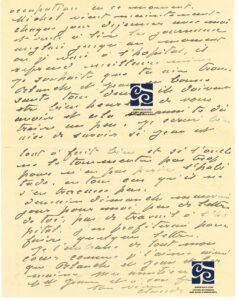
MONET, CLAUDE (1840-1926) Revered French Impressionist painter; his painting Impression, Sunrise is the inspiration for the term Impressionism. Increasing scarce, and of the highest order: Autograph Letter Signed, “your old man, Claude,” in French, on imprinted “SAVOY HOTEL, EMBANKMENT GARDEN, LONDON”, stationery. Four very full pages, octavo. “Saturday 5:30 in the afternoon”, no year, but most likely February 1900. Monet writes to his wife Alice Hoschede:
“Saturday, 5:30 in the afternoon.
Again, I’m rushing back from the Hospital and I’m quite tired, just tired from work. I decided to go early; you’ll see, it’s the surest way to do something useful there; believe me, it’s wonderful in all weathers.
I’m glad to hear about Marthe’s letter, but I’d be surprised if she continues to remain silent about the Brooklyn inspection. Besides your letter, I received a very nice one here from Jean-Pierre; it was very thoughtful of him to think of me—it was a great pleasure to receive it. I also received a letter from Jacques, who still seems to me to be entangled in these affairs, always asking for help. What is most worrying to my mind is that he looks unoccupied. He has sent a great many photographs to Michel, and I fear that is his main occupation at the moment.
Michel comes to breakfast with me every day and stays reading the English newspapers until I leave for the Hospital; he looks better. I hope you found Blanche and Jean both in good health. They must be very happy to have you around, and that will also serve as a distraction for you. I would be very pleased to know if Jean is completely well now, and if the flu is no longer bothering him, so that he might get over it; in short, that he might at least stop worrying about that issue.
Tomorrow, Sunday, will be a bad day for me: no letter from you, and no work at the Hospital. I’ll take advantage of the day to write some letters. I embrace you with all my heart, just as I love you, as well as Blanche, Jean, and Germaine. My regards to Dr. Gravé and his brother.
Your old man, Claude”.
Just an absolutely superb letter with a depth of personal information that is not readily recognized upon first reading, but when put into perspective, elevates the importance of this letter beyond the many that just reflect the daily comings and goings on in Monet’s life there in London, while creating the paintings we recognize as masterpieces today. In brief:
Claude Monet spent four periods in London. One as a young man in exile (September 1870-May 1871), and three painting (April-May 1899, February-March 1900, March-May 1901). During the second one of these last three, the most active indeed, he was already an established and well-off artist. He lived in the luxurious Savoy Hotel on the Embankment and feverishly painted cityscapes. From this period, his most outstanding work is the series of 19 oil paintings entitled The Houses of Parliament in which he portrayed “foggy”, in the new Impressionist style. He painted these now famous views of Westminster Palace from an upper room, which was lent to him, on the terrace of Saint Thomas Hospital, across the Thames.
His life during those weeks was simple: waking up at the hotel, having breakfast, then crossing the river Thames via Westminster Bridge or Waterloo Bridge and painting the scenes that unfolded before him. On his return to the Savoy at the end of the day, he’d spend his evenings at dinner and relaxing, while Sundays were devoted to correspondence. He shared all this time with his son Michel, who accompanied him [as relayed in our letter]. During this period, he had dozens of works in progress, many of which he completed upon his return to Giverny.
In the letter offered here, Monet writes to his wife Alice about these family matters: his daily routine, his tiredness, the advantages of painting from the terrace of the Saint Thomas Hospital, the letters he received, his nostalgia for home in Giverny, and other issues related to their already adult children.
Alice Raingo Hoschedé Monet, the artist’s second wife, is the recipient of our letter, [although her name does not appear]. Monet had, in fact, been married to Camille Doncieux, with whom he had two sons (Jean and Michel), while Alice had six children from her first marriage to Ernest Hoschedé (Suzanne, Blanche, Jacques, Germaine, Marthe, and Jean-Pierre). Except for Suzanne, who had died a year earlier (1899), all seven children of the blended marriage are mentioned by Monet in this letter.
Regarding Jacques Hoschedé, then around 30 years old, Monet speaks with a critical tone and concern, complaining that he was wasting his time, entangled in his personal life. He also criticizes him for focusing solely on photography, given the large number of photographs he had sent to Michel in London a few days earlier. In 1900, Michel was 21 years old and, being the son of his first marriage, he accompanied the painter daily: they had breakfast together at the Savoy Hotel, [as stated in the letter], where the young Michel spent a considerable amount of time reading English newspapers each morning.
The letter also mentions that Jean-Pierre, Alice’s youngest son, wrote Monet a letter from Giverny, something the painter tells his wife with satisfaction, commenting that her son’s gesture made him happy.
Jean and Blanche are also mentioned. Jean Monet is the eldest son of Monet and Camille Doncieux, later married to Blanche Hoschedé, Alice’s daughter. Jean’s health is a source of concern for the painter, so he conveys to his wife the hope that Jean is already recovering. Blanche, in addition to being Monet’s stepdaughter and daughter-in-law, was a skilled painter, and she assisted Monet in his later work, becoming his right hand, executor of his estate, and the heart of the family home in Giverny until the end of her days in 1947, two decades after Monet’s death.
The artist also sends greetings to Germaine Hoschedé, another of Alice’s daughters, who was portrayed by Monet, along with three of her brothers, in a pastel from ca. 1880, when Monet and Alice were just beginning their relationship, after the death of the artist’s first wife.
Finally, Dr. Lucien Gravé was the Monet-Hoschedé family’s physician in Giverny. It is likely that his brother accompanied him as an assistant or coachman on house calls, hence Monet’s greetings to him as well, given that Dr Gravé had recently been treating Jean.
In addition to all this, a crucial family matter is cryptically alluded to in the letter (“the Brooklyn inspection”) requires clarification: in February 1899, Suzanne Hoschedé (daughter of Alice, sister of Marthe, and stepdaughter of Monet) died in Giverny after a long illness. Suzanne was married to the American Impressionist painter Theodore Earl Butler, a young friend and, in a way, a disciple of Monet. The couple had two young children: Jimmy and Lilly. During Suzanne’s final days, at the age of 30, Marthe Hoschedé, her sister, took care of her niece and nephew.
Following the tragic death of his wife, Butler decided, around October 1899, to return temporarily to the United States to reunite with his family in New York. Marthe traveled with him to help raise the children. During this stay, Butler frequently painted scenes of his city, creating famous canvases in the new Impressionist style, recreating, for example paintings of: The Brooklyn Bridge and the East River, among other iconic landmarks. A few months later, after passing the “Brooklyn inspection,” they returned to France, and Marthe married her sister’s ex-husband, further strengthening Butler’s artistic connection with Monet. The wedding took place in Giverny on October 31, 1900, just a few months after the events described in Monet’s letter, and a remarkable family photograph captured the moment still exists.
Marthe’s silence regarding the progress (or lack thereof) of the Brooklyn inspection is certainly troubling. Everything indicates that she is referring to the paperwork Theodore, Marthe, Jimmy, and Lilly were going through to return to France, something they managed to do shortly afterward, but which, at the time of the letter, had not yet been authorized — a situation that naturally worried Alice and Claude. In this regard, Monet tries to empathize with his wife, saying that he shares her concern.
It’s worth noting here some administrative aspects of the matter: Butler’s two children (Jimmy and Lilly) were U.S. citizens through their father, but they were born and raised in France. They may not have had any difficulty entering the United States in 1899, but getting them out of the country, being that their mother was deceased, could have presented difficulties. The truth is that the administrative office for that type of procedure was located in Brooklyn [New York], and hence the authorization “from Brooklyn” was required for the return trip to France. Finally, in March, just a few weeks after Monet’s letter, which is presented here, the family group was able to travel and reunite with the rest of the family in Giverny.
THIS IS A LETTER OF THE HIGHEST BIOGRAPHICAL IMPORTANCE, and worthy of inclusion in the finest of Impressionist letter collections.
$54,500.00