

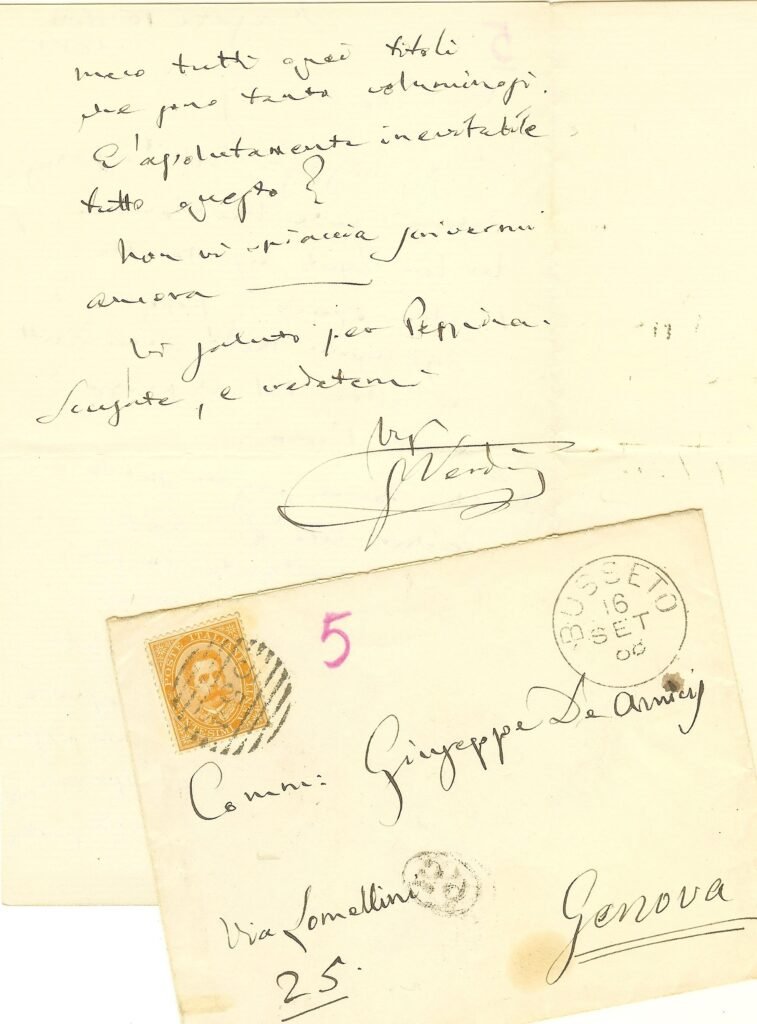
VERDI TO HIS FRIEND AND FINANCIAL ADVISOR ~ ABOUT HIS RAIL ROAD STOCK HOLDINGS
VERDI, GIUSEPPE. (1813-1901). Italian composer; between 1842 and 1853 he was credited with writing a new opera every year, some of immense popularity as his operas related tales in which people’s private and public lives came into conflict; his masterworks include: Rigoletto (1851), Il Trovatore (1853), La Traviata (1853), Don Carlos (1867), and Aïda (1871). Attractive Autograph Letter Signed “G. Verdi”. Two pages, octavo. With original stamped envelope addressed in his hand. “Sant’Agata, September 16, 1888”. To ‘Giuseppe De Amicis’, an engineer based in Genoa who was also a stockbroker. Verdi writes:
“Dear De Amicis, I appreciate the information regarding Mediterranea’s shares, and, if I understood correctly, it would result:
1° That, being the owner of 393 shares of Mediterranea, I would be entitled to another 131 at the price of 500 lire each;
2° That I should pay immediately one tenth [of the total of that amount], that is, 6,550 lire… another tenth in November, another tenth in December; the rest upon request.
All of this might be feasible, but what I find most troubling is having to go ad hoc to Genoa myself, and even more so having to carry all those seemingly bulky documents with me. Is all of this absolutely unavoidable? Please write to me again [on this matter]. I send you greetings from Peppina [his wife]. Excuse me, and believe me [yours,] G. Verdi”.
In this wonderful letter, Verdi’s commentary revolves around the shares of the Società per le Strade Ferrate del Mediterraneo, an Italian railway company that existed between 1885 and 1905. On January 1, 1888, he opened an accounting ledger listing his assets and meticulously documenting his finances. — 1,452,000 lire in real estate, machinery, and livestock, and 1,400,000 lire in bonds, shares, and deposits—including those in Mediterranea, which represented 14% of his total holdings. Our letter reveals the effort Verdi put into managing all these matters, with their deadlines, inconveniences, and underlying weariness, typical of his age.
De Amicis became a close friend of Verdi, as well as his agent, confidant, and manager of some of the composer’s financial investments, and maintained with him a frequent correspondence, especially during the Verdi’s final years. He was also a first cousin of the celebrated writer Edmondo De Amicis, the author of Cuore.
Verdi lived for over 50 years in Sant’Agata, a bucolic village located 40 km from Milan and 100 km from Genoa. During the winters, he enjoyed spending time by the sea, making Genoa his favorite city where he worked on memorable works such as Aida and Simon Boccanegra and Otello. On one occasion, while staying at the Hotel Croce di Malta in the port area of Caricamento, Verdi went for a walk with his wife, Giuseppina Strepponi, known as “Peppina,” when they met by chance on the street the charismatic Giuseppe De Amicis, an effusive civil engineer, with whom they shared class codes and social circles. Chatting about the hotel’s limitations, De Amicis offered to find them better accommodations in the city next time, as he lived there and had many contacts. From then on, De amicis acted as Cicerone and informal secretary to the Verdi family in Genoa, taking care of finding them housing, hiring servants and employees, and even solving minor things, such as having a cage painted for the family parrot at Peppina’s request.
$4500.00